
Dental Implants • 9 min read • Kanpur
Dental Implants in Kanpur: How Long They Last and How to Care for Them
Evidence-based longevity data, a stage-by-stage look at the implant journey, and the daily habits that decide whether your implant is still standing in 20 years.
If you are searching for dental implants in Kanpur, the first question almost every patient asks is not about colour or comfort — it is about time. “How long will this actually last?” The honest answer is that a well-placed implant, cared for properly, can easily function for 15 to 25 years, and many patients keep them for a lifetime. The less honest answer is that an implant that is neglected can fail in a decade. This guide walks through everything that sits between those two outcomes: why missing teeth quietly destroy jawbone, how an implant compares to a bridge or a denture, what happens on the day of surgery and during healing, and the maintenance routine that separates a twenty-year implant from a ten-year one.
In This Guide
- Missing teeth and bone loss in Kanpur adults
- Implant vs bridge vs denture: a clinical comparison
- What happens during implant placement
- Implant longevity, osseointegration and success
- Post-implant maintenance: brushing, flosser, sugar, reviews
- Questions to ask before choosing an implantologist
- Book an implant consultation at Saluja Dento Max
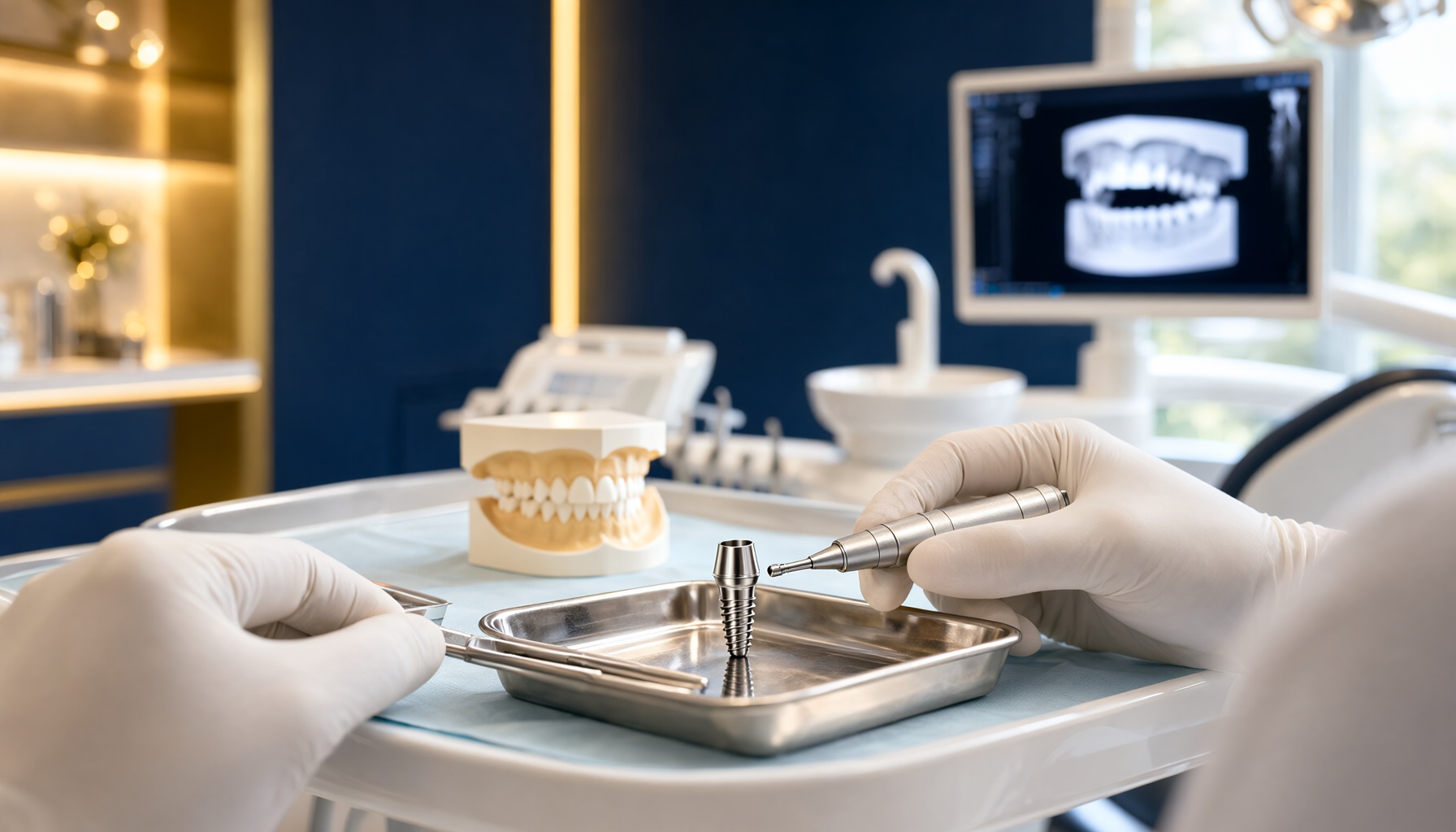
Chapter 1: Missing Teeth and Bone Loss — Why a Lower-Jaw Gap Changes Fast
A missing tooth is not a cosmetic problem. It is a mechanical and biological one. The moment a tooth is removed, the bone that once held it begins to resorb — a process that is fastest in the first twelve months and never fully stops. Research consistently shows measurable ridge reduction within the first 6–12 months, and the lower posterior jaw is often the most affected region because it carries the heaviest chewing loads and is frequently the site of first molar loss.
The consequences cascade. Neighbouring teeth tilt into the gap, contact points open, plaque traps form, and chewing efficiency drops by up to 30% in partially edentulous patients. When a single molar is missing and is not replaced, the opposing tooth often over-erupts within 18–24 months. This is why adults in Kanpur frequently arrive at a clinic complaining not of a missing tooth but of “my bite has changed” or “my jaw feels different.”
Illustrative ridge volume loss after an unreplaced lower molar
Approximate change in supporting bone height relative to the extraction date, based on published ridge-resorption literature.
The clinical message: the longer a gap is left unfilled, the more grafting and the more complex the later implant surgery becomes.
This is where socket preservation enters the conversation. At the time of extraction, a clinician can place a bone graft material into the empty socket and stabilise it with a collagen membrane. It does not stop resorption entirely, but in controlled studies it reduces horizontal ridge reduction substantially compared with spontaneous healing. The practical takeaway for anyone comparing options is simple: replacing a missing tooth early is not only about appearance — it protects the bone that future implants, bridges and even dentures will need.
Three local habits that accelerate bone loss around a gap
- Smoking — nicotine causes vasoconstriction, reduces local blood flow and is consistently identified in systematic reviews as a risk factor for peri-implant disease.
- Uncontrolled diabetes — among non-smokers with diabetes and hyperglycaemia, studies report roughly a 3.4-fold higher risk of peri-implantitis compared with normoglycaemic individuals.
- Skipping the six-monthly review — peri-implant disease is silent until it is advanced. The early stage, peri-implant mucositis, is entirely reversible if caught in time.
Chapter 2: Implant vs Bridge vs Denture — A Clinical Comparison
Patients searching for the best dental implant clinic in Kanpur are usually comparing three options, often without real clinical data. The table below is an honest side-by-side look, not a sales pitch. Note that no option is universally best — a two-tooth gap with healthy abutments may be perfectly served by a bridge, while a single missing molar with intact neighbouring teeth is the classic implant indication.
| Parameter | Dental Implant | Conventional Bridge | Removable Denture |
|---|---|---|---|
| Effect on adjacent teeth | None — no healthy tooth is cut | Requires preparation of two healthy teeth | None, but clasps may stress abutments |
| Bone preservation | Maintains load-bearing bone; prevents resorption | Bone under the pontic resorbs over time | Bone resorbs; resorption continues |
| Typical service life | 15–25+ years with good maintenance | 7–15 years, often needing replacement sooner | 5–10 years before relining or remake |
| Cleaning | Brush + interdental brush/flosser, lifelong | Special floss under pontic, meticulous | Removed daily for cleaning |
| Comfort | Felt like a natural tooth; no pressure points | Fixed, but cement margin can trap food | Bulk, movement, possible gag reflex |
| Bone grafting need | Often, if ridge has resorbed | Not usually | Not applicable |
| Suitability for a diabetic patient | Conditional — requires good glycaemic control | Often suitable | Suitable; lowest surgical load |
| Risk profile | Peri-implantitis if hygiene lapses | Secondary caries at crown margins | Ulceration, fungal infection, bone loss |
A useful rule of thumb: an implant replaces a tooth, while a bridge replaces a tooth and pays for it with two other teeth. Over a 20-year horizon, that biological cost compounds. That is the strongest clinical argument for implants in the single-tooth case.
Expected service life by replacement option
Typical documented ranges under normal clinical conditions and reasonable patient maintenance.
Ranges reflect published long-term reviews. Individual outcomes vary with bone quality, hygiene, smoking, systemic health and review compliance.
Chapter 3: What Actually Happens During Implant Placement
The word “surgery” creates more anxiety than it should, because most implant patients are under local anaesthesia and do not feel the procedure. Understanding the stages removes most of that fear — and helps you judge whether a clinic is following a genuinely modern protocol.
Consultation & medical history
Assessment of your general health, diabetes status, smoking, medication (especially bisphosphonates or blood thinners), previous dental work and aesthetic expectations. Intraoral photographs and an oral cancer screening are standard.
CBCT 3D imaging
A cone-beam CT scan replaces guesswork. It measures ridge width and height, maps the sinus floor and inferior alveolar nerve, reveals residual infection, and allows a virtual placement of the implant before anything is done. This is the single biggest upgrade in implant planning over the last two decades.
Surgical placement
Under local anaesthesia, a small access is made in the gum, a sequenced osteotomy is prepared to the planned depth, and the titanium fixture is inserted with controlled torque. A healing cap is placed. Most appointments take 45–90 minutes per implant.
Osseointegration (3–6 months)
Living bone grows directly onto the implant surface with no soft tissue in between. Soft tissue typically settles in 1–2 weeks. Cleveland Clinic notes the full process may take anywhere from three to nine months depending on the site and the patient.
Impression & crown
Once stability is confirmed, a digital or conventional impression is taken and a custom crown is fabricated. Implant-supported prostheses typically take 1–2 weeks in the laboratory, then are cemented or screw-retained.
Review & maintenance phase
A check at 1 week, again at 3–4 months, then every six months for life. This stage is where implants are actually protected — and where most neglected implants are lost.
| Healing stage | Typical timeframe | What the patient experiences |
|---|---|---|
| Surgical wound | 0–14 days | Mild to moderate swelling and tenderness; settles within 7–10 days |
| Soft tissue seal | 2–6 weeks | Gums firm up; slight recession may occur as tissue matures |
| Early bone contact | 6 weeks – 3 months | No symptoms; implant remains unloaded or in temporary restoration |
| Full osseointegration | 3–6 months (up to 9 in grafted sites) | Stability confirmed; final crown fabricated |
| Prosthetic loading | From ~4 months | Normal chewing restored; no special restrictions thereafter |
| Maintenance recall | Every 6 months, lifelong | Probing, professional cleaning, radiograph comparison |
Chapter 4: Implant Longevity and Osseointegration — What Really Determines Success
Let us look at the numbers, because they are reassuring. A widely cited systematic review and sensitivity meta-analysis by Howe, Keys and Richards (Journal of Dentistry, 2019) pooled contemporary implant studies and estimated 10-year implant-level survival at 96.4% (95% CI 95.2%–97.5%), with a prediction interval of 91.5%–99.4%. A 2024 twenty-year meta-analysis in Clinical Oral Investigations concluded that survival rates remain above 90% even at the decade mark. Single-tooth implant crowns have separately been reported at around 89.5% survival over ten years — slightly lower than the implant fixture itself, which is a useful reminder that the crown and abutment are the replaceable components.
Long-term implant survival from the evidence base
Implant-level survival estimates reported in long-term systematic reviews and meta-analyses.
Sources: Howe et al. 2019 (10-year meta-analysis, 96.4%); 2024 20-year meta-analysis (>90% at 10 years); single-tooth crown survival ~89.5% at 10 years.
Survival and success are not the same. Survival means the implant is still in place. Success means it is functional, aesthetically acceptable, infection-free and surrounded by healthy bone. Many implants survive while slowly losing supporting bone to peri-implant disease — which is why a radiograph at every six-monthly review matters more than “is my crown still there?”
The most common cause of late implant loss is not failed initial healing. It is peri-implantitis developing years afterwards — an inflammatory destruction of the bone supporting an implant, triggered by plaque biofilm. A 2024 umbrella review concluded that a history of periodontitis and cigarette smoking are highly suggestive risk factors, while a 2025 systematic review identified periodontitis and smoking as risk indicators for both peri-implant disease and peri-implant mucositis. In short: the bone that surrounds an implant behaves like the bone around a natural tooth, and it responds to the same neglect.
What genuinely determines long-term implant success
Relative influence of modifiable and non-modifiable factors on implant longevity, based on risk-indicator reviews.
Relative weighting is indicative for patient education; the strongest modifiable lever is plaque control combined with regular professional maintenance.
- 3D-planned, prosthetically-driven placement — an implant positioned by the final crown design, not by guesswork, produces better soft-tissue aesthetics and easier cleaning.
- Implant brand and surface — well-documented systems with a proven clinical record and surface conditioning give more predictable integration than unbranded components.
- Bone quality and quantity — dense anterior bone integrates faster and more predictably than soft posterior bone. This is where grafting decision-making matters most.
- Systemic health control — glycaemic control, blood pressure management and no smoking during the healing window materially affect osseointegration.
- Abutment emergence design — emergence angles beyond roughly 30° are harder to clean and are recognised risk indicators for peri-implant disease.
- Residual cement removal — leftover subgingival cement is a documented trigger for peri-implant inflammation and is fully preventable.
- Lifelong maintenance — the single biggest controllable factor. An implant patient is a patient for life, not a patient for one visit.
Chapter 5: Post-Implant Maintenance — Brushing, Water Flosser, Sugar and Reviews
This is the chapter that decides your implant’s twentieth year. Titanium does not decay and it does not get cavities — but the gum tissue around it is living tissue, and it can be destroyed by exactly the same biofilm that destroys bone around a natural tooth. Care for an implant is not more complicated than caring for a natural tooth; it is differently focused. The crown margins and the gum line are the priority, not the chewing surfaces.
Brush twice daily with a soft or implant-specific brush
Use an electric toothbrush with a pressure sensor where possible, a soft-bristled manual brush, or interdental brushes sized to the gum line. Angle the brush 45° toward the gum margin and use small circular motions — a scraping motion is wrong.
Clean between the teeth every single day
Where a natural tooth has floss contacts, an implant has a gap. A water flosser is excellent, but on wider embrasures a small interdental brush is the gold standard. If you only remember one habit from this article, remember this one.
Control sugar frequency, not just quantity
Frequent sugar exposure — sipping chai with sugar all morning, sweetened tea, biscuits between meals — keeps the pH low for hours. Cavities do not form around implants, but acidic, sugar-driven biofilm drives peri-implant mucositis. One sweet beverage a day is safer than six small sweetened sips.
Attend the six-monthly implant recall
At every visit the clinician measures probing depths, checks bleeding on probing, removes plaque and calculus from the implant surface and compares radiographs against your baseline. Peri-implant mucositis is reversible at this stage; established peri-implantitis is not.
Treat the cause, not just the symptom
Untreated bleeding gums, a history of periodontitis, a grinding habit or a poorly fitted denture elsewhere in the mouth will keep destabilising the implant. Treat the whole mouth.
| Interval after implant | What is done | Why it matters |
|---|---|---|
| 24–72 hours | Rinse gently, soft diet, no rinsing mouthwash for 24h | Protects the early clot and the soft-tissue seal |
| 1 week | Suture review, wound check | Detects dehiscence or early infection early |
| 3–4 months | Osseointegration check, provisional restoration | Confirms stability before loading the implant |
| 6 months | First full maintenance visit | Baseline probing depths and radiograph recorded |
| Every 6 months thereafter | Probing, professional decontamination, radiograph review | Detects peri-implant disease while it is still reversible |
| Annually | Restoration integrity, occlusion, screw/cement check | Prevents chipping, loosening and overload |
Guidance aligned with peri-implant disease risk-indicator reviews published in the Journal of Periodontology (2020) and peri-implantitis risk umbrella reviews (2024).
Chapter 6: Questions to Ask Before Choosing an Implantologist in Kanpur
Choosing the best dental implant clinic in Kanpur should not depend on advertising. It should depend on answers. Bring this list to your consultation and ask it out loud — a confident, transparent clinician will welcome every question.
- “Do you use 3D CBCT imaging, and will you show me the virtual implant plan before surgery?” — If the answer is no, planning is being done on a flat 2D film.
- “Who will actually place the implant — the person I am consulting, or someone else?” — Implant surgery is skill-dependent. Ask for the surgeon’s credentials and training specifically in implantology.
- “Which implant system are you using, and is it documented in peer-reviewed trials?” — Established, traceable systems beat unknown components every time.
- “Do I need a bone graft, and how will you know?” — Grafting should be decided from CBCT data, not from a hopeful estimate.
- “What is your follow-up schedule, and what happens if I lose the implant?&strong> — A clinic without a structured lifelong recall programme is not offering long-term care.
- “How do you manage patients with diabetes or a smoking history?” — Screening, stabilisation and honest risk counselling should be standard.
- “Will my treatment be coordinated with a prosthodontist or restorative dentist?” — Implant placement and crown design should never be separate decisions.
“An implant is not a purchase that ends at the crown. It is a thirty-year relationship between a surgical plan, a maintenance routine and a patient who keeps showing up.”
Key Takeaways
Dental implants in Kanpur are among the most predictable tooth-replacement options available today. The pooled evidence points to roughly 96% ten-year implant survival, and individual implants frequently exceed twenty years in function. But survival is a partnership outcome, not a product guarantee. Replace the gap early to protect the bone. Choose 3D-planned, prosthetically-driven placement. Control plaque with daily interdental cleaning. Manage sugar frequency, diabetes and smoking. And attend the six-monthly recall for the rest of your life.
If you are still comparing options, book a consultation. A good implant consultation should end with a CBCT-based plan, a clear maintenance schedule and a written follow-up commitment — not pressure.
Ready to Discuss Your Implant Options?
Visit Saluja Dento Max Fac Centre for a structured implant consultation — clinical examination, 3D imaging, a written treatment plan and a lifelong maintenance roadmap. No guesswork, no rushed decisions.
Book a ConsultationExplore our full range of services at salujadentals.com or read more in our dental implants and preventive care sections.
Related Articles
Clear Aligners vs Braces for Adults in Kanpur: A Full Guide
Cosmetic & Aesthetic Dentistry • 11 min read Clear Aligners vs Braces for Adults in Kanpur: How Each…
What Is Osseointegration in a Dental Implant? | Kanpur Guide
Dental Implants · Implantology · 9 min read What Is Osseointegration — and Why It Decides Whether Your…
What Is Osseointegration? How a Dental Implant Fuses With Bone
Dental Implants • 12 min read What Is Osseointegration? Why a dental implant must literally grow into the…